
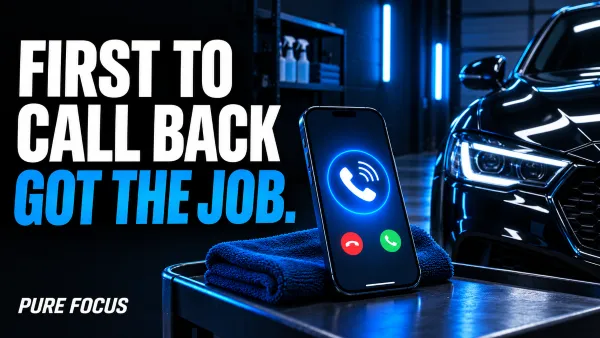
The First to Call Back Got the Job | Pure Focus
November 6, 2026 · @Chad Engelke
Three calls, three voicemails
I needed my car detailed before I left town. I was short on time, so I called a mobile detailer.
Straight to voicemail. I left a message.
I couldn't wait around, so I asked on Facebook for referrals. I got two more names. I called the second one. Voicemail. I left a message. I called the third one. Voicemail again. Another message.
Here's how it played out:
The third detailer, the last one I called, called me back in about 10 to 15 minutes. We talked, I booked a time that fit my schedule, and they got the job.
The second one called me back the next day. Too late.
The first one has never called me back.
Same town. Same service. Same customer. The only difference was how fast they responded. The one who called back first got paid. The other two never knew they lost a job.
Then I looked at my own phone
Being on the customer side of that stung. Because it made me ask a hard question: how many calls was I missing at Pure Focus?
The honest answer was more than I wanted to admit. I'm in meetings. I'm on shoots. I'm out in the community. Calls go to voicemail.
So I set up an AI assistant to answer for me. It works across my phone, Facebook, and Instagram. When someone reaches out, it acknowledges them right away, gets their contact information, and figures out what they need.
It also tells people up front that it's Pure Focus's AI assistant. I don't want anyone thinking they're talking to a real person when they're not. Its job is simple: make sure nobody gets ignored, and get enough information so my first conversation with them is a good one.
If a call slips past it, a text goes out automatically: "Hey, we missed your call. How can we help?" When they reply, it walks them through a few questions to find out what they're looking for.
I'm still learning the best way to set this up. But nobody who reaches out to me hits a dead end anymore.
You don't have to answer. You have to acknowledge.
Most people understand you can't pick up every call. Especially if you're a one-person shop or a service business out on a job. What they won't accept is silence.
There's research behind this, and it's not new. A 2011 study published in Harvard Business Review audited 2,241 US companies on how fast they responded to web leads. Only 37% responded within an hour. Among the companies that responded within 30 days, the average wait was 42 hours.
The companies that reached out within an hour were nearly 7 times as likely to have a real conversation with a decision-maker as companies that waited even one hour longer. Companies that waited a day or more did more than 60 times worse.
That study is 15 years old. If anything, people expect faster replies now than they did then.
The fix can be simple. My phone has a quick reply I can send with one tap when I'm in a meeting: "I'm in a meeting. I'll call you back." Or, if I'm on a webinar and can handle it by text: "Please text me." It takes two seconds. The caller knows I got their call, and I know they're not dialing my competitor.
When I was in other sales roles, I heard the same line too many times after calling back late: "Thanks, but we already found someone." Once you hear that, the job is gone.
Fast doesn't mean booking everyone
Speed is about making sure everyone hears back. It doesn't mean everyone gets the same next step.
My assistant sorts people as they come in. If someone looks like a fit, like a business that wants to find where it's losing leads or needs a video project, it sends them to my booking calendar. If they made it there, I know they've already been filtered.
Other calls are different. Some people want to work for me. Some want to sell me something. Some want work that's outside what I do. They don't get a spot on my calendar. The assistant takes their name, number, and email so I can reach back out the next business day, or it gives them my email so they can tell me what they need.
That matters because it's easy to misjudge someone on a first call. A person who looks like a bad fit might turn into a big client. So nobody gets dropped. Everyone gets touched fast. They just don't all go to the same place.
How fast are you, really?
When I sit down with a business owner, I don't guess at their response time. I ask. Sometimes their phone rings while we're talking, and that tells me a lot.
If you skip a call to stay in our meeting, I respect that. Then I ask what happens next. Try these on your own business:
If someone called right now and you didn't answer, what would they get?
Does anything respond for you, like an AI assistant or an automatic text?
When you're in a meeting, do you send a quick "I'll call you back"?
After the meeting, do you call back right away, or does it wait until the end of the day?
How long does a web form or Facebook message sit before someone answers it?
Most owners know the answers once they hear the questions. If any of yours made you wince, that's your leak.
Find out where you stand
Speed-to-lead is the fourth of seven places businesses lose leads. You can be found, trusted, and contacted, and still lose the job because someone else called back first.
The Full Frame Assessment scores your business across all seven. It takes a few minutes, and your results come by email.
https://purefocus.media/full-frame-assessment
Next up: follow-up, and what happens to the people who say "not yet."
Source: James B. Oldroyd, Kristina McElheran, and David Elkington, "The Short Life of Online Sales Leads," Harvard Business Review, March 2011. Figures as reported by SmartCompany.